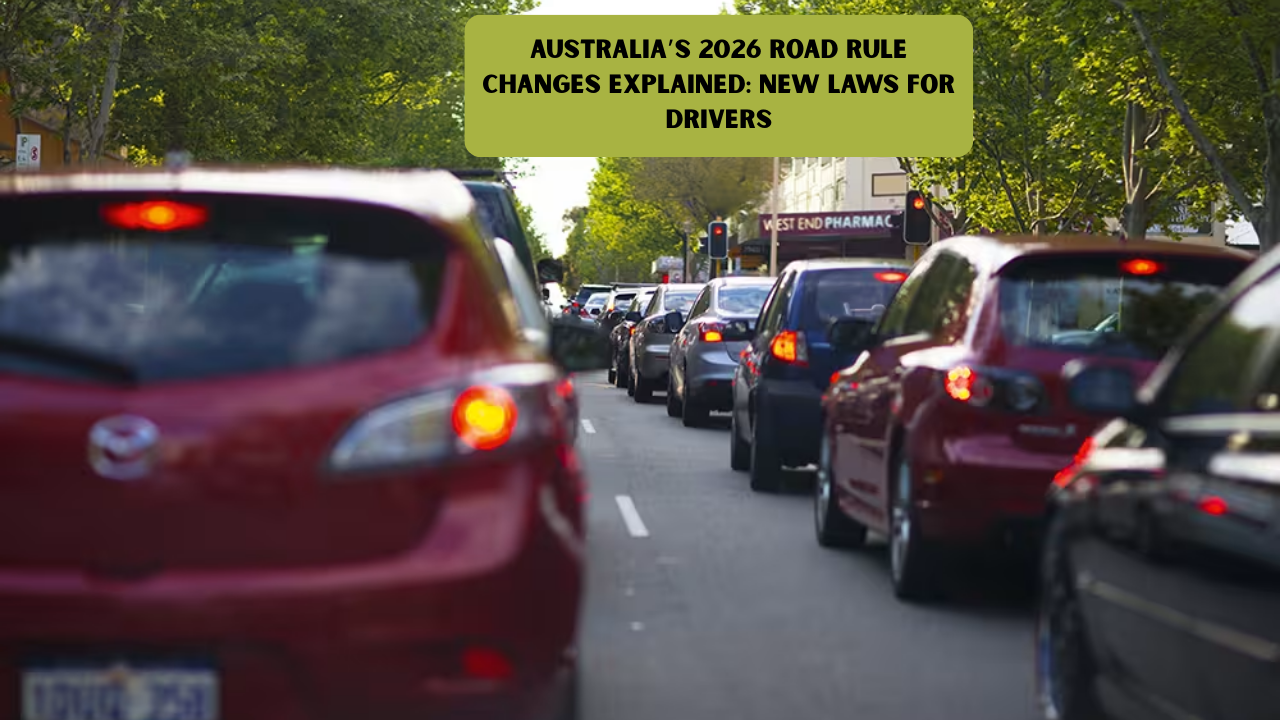
As we move into 2026, motorists across Australia are facing a significant overhaul of traffic regulations. These updates, driven by the National Road Safety Strategy, aim to curb rising road tolls through a combination of high-tech enforcement and stricter behavioral mandates.2 While the core “Australian Road Rules” provide a national framework, 2026 marks a year where states like New South Wales, Victoria, and Queensland are introducing specific, localized amendments that every driver must understand to avoid heavy financial penalties and license suspensions.
The Rise of AI-Powered Enforcement
One of the most profound shifts in 2026 is the nationwide expansion of AI-driven camera systems.4 Following successful trials in 2025, these cameras are no longer just for speeding or red lights; they are now programmed to detect seatbelt misuse and mobile phone distraction with surgical precision.5 In states like New South Wales and the ACT, these systems can even identify if a passenger is unrestrained, holding the driver liable for a “double whammy” of fines. This technology works 24/7, even in low-light conditions, making the era of “hidden” distractions a thing of the past for Australian commuters.
New Speed Dynamics in Urban Zones
Motorists will notice a “slowing down” of major city centers and suburban hubs.6 In 2026, the rollout of 30 km/h zones is accelerating in high-pedestrian areas and school precincts.7 Queensland and Victoria are leading this charge, reclassifying many former 50 km/h residential streets to 40 km/h or lower. This change is backed by data suggesting that a pedestrian’s survival rate increases significantly when vehicle speeds are kept under 40 km/h. Drivers should be particularly vigilant of the new “time-based” limits in South Australia, where the 25 km/h school zone rule remains one of the strictest in the country.
Protection for Roadside Assistance and Emergency Workers
A critical legislative change for 2026 involves the “Slow Down, Move Over” laws.8 Previously, these rules primarily protected police and ambulance vehicles.9 Now, the mandate has expanded in most jurisdictions to include tow trucks, breakdown service vehicles (like the RACV or NRMA), and even garbage trucks with flashing lights.10 In most states, you must now reduce your speed to 40 km/h (or 25 km/h in SA) when passing these stationary vehicles on any road type, including freeways.11 Failure to comply can result in fines exceeding $900 and an immediate loss of demerit points.
2026 Penalty Reference Table
The following table outlines the estimated maximum penalties and demerit point impacts for common offenses under the updated 2026 framework.
| Offence Category | Estimated Max Fine (AUD) | Demerit Points | Key 2026 Requirement |
| Mobile Phone Distraction | $1,200 – $1,250 | 4 – 5 Points | Detection via AI traffic cameras |
| Seatbelt Misuse | $423 – $1,100 | 3 Points | Applies to driver and all passengers |
| School Zone Speeding | $1,100+ | 5 – 7 Points | Increased focus on 30 km/h zones |
| Passing Emergency/Tow Vehicles | $961 | 3 Points | Slow to 40 km/h (25 km/h in SA) |
| Running a Red Light | $600 – $900 | 3 Points | Expanded red-light camera network |
Stricter Licensing for Seniors and High-Performance Drivers
2026 introduces a more rigorous national standard for licensing, particularly for older drivers and those operating high-powered vehicles.13 Western Australia and the Northern Territory have now fully adopted the national framework requiring drivers aged 75 and over to undergo mandatory medical assessments to retain their license. Furthermore, some states are introducing a new “Ultra High-Powered Vehicle” (UHPV) license category.14 This requires drivers of cars with specific power-to-weight ratios to complete specialized safety training, ensuring they can handle high-torque engines safely in public traffic.
Average Speed Cameras for Light Vehicles
Historically, “point-to-point” or average speed cameras were reserved for heavy trucks on major highways.16 As of 2026, this technology is being fully integrated for light vehicles (passenger cars and motorcycles) across several major corridors, including the Pacific and Hume Highways.17 These systems calculate your speed over a long distance rather than at a single point. This means that slowing down just for a visible camera and speeding up afterward will no longer prevent a fine, as your average pace for the entire journey is what triggers the infringement.
Electric Vehicle (EV) and Technology Mandates
Finally, 2026 brings new regulations for the growing fleet of electric vehicles.19 A major update to the Australian Design Rules (ADR 113/00) now requires all new-model EVs, hybrids, and hydrogen vehicles sold in Australia to be equipped with an Acoustic Vehicle Alerting System (AVAS).20 This system emits a sound at low speeds to alert pedestrians and the vision-impaired of the vehicle’s presence. While existing EV owners do not need to retrofit their cars, new buyers will notice these “artificial hums” becoming standard equipment on the showroom floor.

FAQs
1. Do I need to install a noise-maker (AVAS) on my older electric car?
No. The 2026 mandate only applies to new-model vehicles sold after the implementation date. Existing EV owners are not required to retrofit their vehicles with acoustic alerting systems.22
2. Are the 30 km/h speed limits active all day?
It depends on the signage. Most 30 km/h and 40 km/h zones in school areas are time-based (e.g., 8:00 AM – 9:30 AM), but many high-pedestrian “shared zones” or CBD blocks are now permanent 24/7 limits.
3. Does the “Slow Down” rule apply if the emergency vehicle is on the other side of the road?
Generally, the rule applies to vehicles traveling in the same direction or on undivided roads. If there is a median strip or physical barrier separating the traffic, you usually do not need to slow to 40 km/h, though caution is still advised.
Disclaimer:
The content is intended for informational purposes only. You can check the official sources as our aim is to provide accurate information to all users.